

Smarter Ways Startups Can Avoid Software Development Delays
- 1. Introduction
- 2. Why Software Development Delays Hit Startups Harder
- 3. Unclear Requirements: The Silent Delay Trigger
- 4. Poor Project Management (Not Just a “Big Company” Problem)
- 5. Overloading the Team with Features
- 6. Choosing the Wrong Development Partner
- 7. Ignoring Technical Debt Early On
- 8. Communication Gaps Between Business and Tech
- 9. Underestimating Testing and QA
- 10. Insight: Delays Are More Common Than You Think
- 11. How the Right Partner Helps Startups Move Faster (Not Slower)
- 12. Conclusion
Introduction
For startups, time isn’t just money; it’s survival.
A delayed product launch can mean missed funding, lost early adopters, or being overtaken by competitors. Yet software development problems remain one of the most common reasons startups fail to hit their timelines.
The irony? Most delays are preventable.
Let’s break down why startups face development slowdowns, how these startup issues snowball, and, more importantly, smarter ways to avoid becoming a delayed startup.
Why Software Development Delays Hit Startups Harder
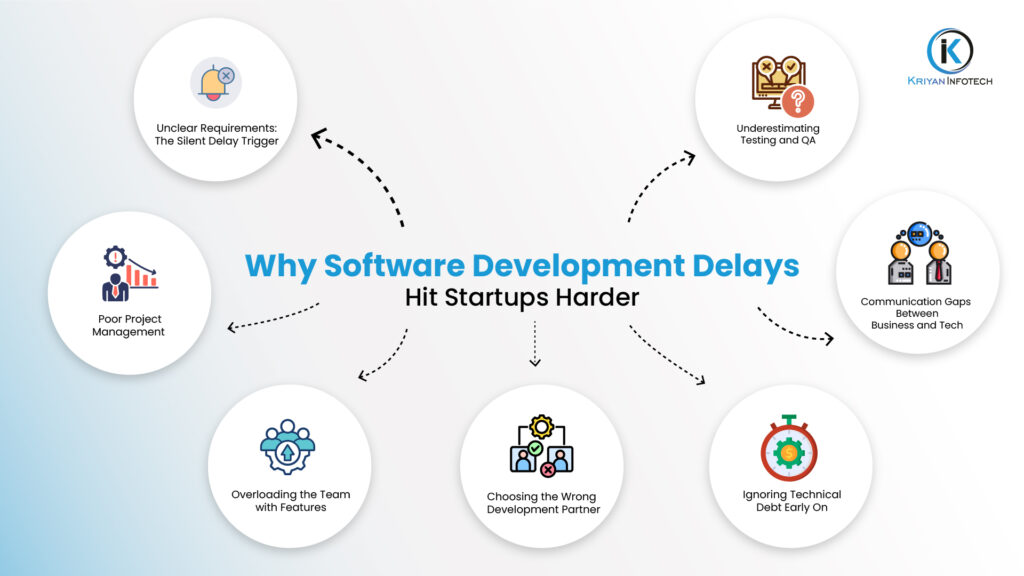
Large enterprises can absorb delays. Startups can’t.
When a project slips, it often triggers a chain reaction:
- Burn rate increases
- Investor confidence weakens
- Team morale drops
- Market opportunities close
A delayed startup phase can quickly turn into a stalled business phase if not handled early.
Understanding the root causes of common software development problems is the first step toward fixing them.
1. Unclear Requirements: The Silent Delay Trigger
One of the biggest software development problems startups face is unclear or constantly changing requirements.
Early-stage founders often say:
“Let’s just build something and refine it later.”
That approach almost always leads to:
- Rework
- Scope creep
- Confusion between business and tech teams
This isn’t agility; it’s chaos.
Without clarity, even the best developers struggle, resulting in slow software development and missed milestones.
Smarter approach:
Define a realistic MVP. Document what’s in scope and what’s not. Clarity upfront saves weeks later.
2. Poor Project Management (Not Just a “Big Company” Problem)
Many founders underestimate the importance of management in software project execution.
They assume:
- Developers will “figure it out.”
- Tools alone can manage timelines.
- Daily stand-ups = project management
In reality, weak planning leads to overlapping tasks, unclear ownership, and constant firefighting, classic startup issues.
Without structured management, projects drift. And drifting projects become delayed projects.
3. Overloading the Team with Features
Startups often try to do too much, too soon.
More features ≠ better product.
This mindset creates common software development problems, such as:
- Bloated backlogs
- Longer testing cycles
- Increased bugs
- Delayed releases
Feature overload is a guaranteed way to create slow software development, especially with small teams.
Smarter approach:
Build for validation, not perfection. Ship what users need now, not what might be useful later.
4. Choosing the Wrong Development Partner
Not all delays come from inside the startup.
Many software development problems begin with selecting a partner who:
- Overpromises timelines
- Lacks startup experience
- Doesn’t understand business goals
This mismatch often turns into a delayed startup, where founders feel stuck midway with no clear exit.
This is why working with an experienced, business-aligned technology partner matters.
Companies like Kriyan Infotech focus on outcome-driven development, balancing speed, scalability, and clarity instead of just writing code.
You can explore their service-led approach at Kriyan Infotech.
5. Ignoring Technical Debt Early On
Rushing development without proper architecture leads to fragile systems.
Initially, it feels fast. But soon:
- Small changes take longer.
- Bugs multiply
- Refactoring becomes unavoidable
This technical debt is a major contributor to slow software development over time.
Startups often pay twice:
- Once for fast, messy development
- Again, to clean it up.
Avoiding this early prevents long-term software development problems.
6. Communication Gaps Between Business and Tech
Founders speak business. Developers speak technology.
When there’s no bridge between the two, misunderstandings pile up:
- Features built incorrectly
- Assumptions made instead of clarified
- Delays caused by rework
This communication breakdown is one of the most underestimated startup issues.
Good management in software project execution ensures everyone understands why something is being built, not just what.
7. Underestimating Testing and QA
Testing is often treated as an afterthought until things break.
Skipping or rushing QA leads to:
- Bug-filled releases
- Emergency fixes
- Reputation damage
Ironically, poor testing is a top reason for delayed startup launches because issues surface after development is “done.”
Smarter teams integrate testing throughout the development cycle, not at the end.
Insight: Delays Are More Common Than You Think
According to a study by McKinsey, large IT projects run 45% over budget and 7% over time on average.
For startups with fewer buffers, even smaller overruns can be fatal.
How the Right Partner Helps Startups Move Faster (Not Slower)
Avoiding delays isn’t about rushing; it’s about structure.
This is where experienced partners like Kriyan Infotech make a difference by:
- Translating business goals into technical roadmaps
- Applying realistic timelines
- Enforcing disciplined management in software project workflows
- Preventing scope creep before it derails progress
Their development approach is designed specifically to reduce common software development problems that cause startups to stall.
Learn more about their startup-focused development services at Kriyan Infotech.
Conclusion
Every startup wants to move fast. But speed without structure leads to delays.
Most software development problems don’t appear overnight; they build gradually through small, avoidable mistakes.
If you want to avoid becoming a delayed startup, focus on:
- Clear requirements
- Strong project management
- The right development partner
- Realistic expectations
Because the smartest startups don’t just build fast.
They build right and launch on time.