
Multi-Cloud vs Hybrid Cloud: What Should Your Business Choose?
- 1. Introduction
- 2. Understanding Cloud Deployment Models
- 3. What Is Hybrid Cloud?
- 4. What Is Multi-Cloud?
- 5. Multi-Cloud vs Hybrid Cloud: Core Differences
- 6. Example
- 7. Cloud Infrastructure Strategy: Where to Start
- 8. Cloud Workload Distribution
- 9. Cloud Security Considerations
- 10. Cloud Cost Optimization in Real Terms
- 11. Integration Challenges to Expect
- 12. Performance Management Across Clouds
- 13. When Multi-Cloud Is the Right Choice
- 14. When Hybrid Cloud Is the Right Choice
- 15. Enterprise Cloud Adoption Trends
- 16. Conclusion
Introduction
Cloud adoption is no longer a competitive advantage. It is a baseline requirement. Yet, as organisations mature in their cloud journey, one question repeatedly slows down decision-making: Should we adopt a multi-cloud approach or invest in a hybrid cloud architecture?
From a business leader or operations head’s perspective, this choice is not about trends. It directly impacts cloud cost optimization, security posture, performance reliability, and long-term scalability. The wrong decision can lock you into inflexible contracts or create unnecessary operational complexity.
So, choose a cloud infrastructure strategy that actually fits your needs.
Understanding Cloud Deployment Models
Before comparing multi-cloud vs hybrid cloud, it helps to clarify the core cloud deployment models businesses rely on today.
- Public cloud platforms like AWS, Azure, and Google Cloud offer scalable, pay-as-you-go infrastructure with rapid deployment.
- Private cloud environments provide dedicated infrastructure, often preferred for sensitive workloads.
- On-prem plus cloud setups combine local infrastructure with cloud services, forming the foundation of hybrid models.
Each approach serves different goals. The challenge begins when organisations attempt to scale, optimise costs, or meet compliance requirements across environments.
What Is Hybrid Cloud?
A hybrid cloud architecture combines on-premise infrastructure or private cloud with one or more public cloud services. These environments are connected, so workloads, data, and applications can move between them when needed.
- Architecture
Hybrid cloud typically uses secure networking, unified identity management, and orchestration tools to bridge internal systems with external cloud platforms.
- Common Use Cases
- Legacy system coexistence with modern cloud applications
- Compliance-heavy industries like healthcare, finance, and government
- Gradual cloud migration without disrupting core operations
- Infrastructure Structure
Businesses maintain critical data or workloads on-prem while using the public cloud for scalability, analytics, or customer-facing applications.
What Is Multi-Cloud?
A multi-cloud strategy involves using services from multiple public cloud providers simultaneously. Instead of relying on a single vendor, businesses distribute workloads across different platforms.
- Multi-Provider Strategy
For example, a company may run analytics on Google Cloud, customer applications on AWS, and enterprise integrations on Azure.
- Vendor Flexibility
This approach reduces dependence on a single provider and gives businesses negotiating power.
- Redundancy Benefits
Multi-cloud environments improve uptime and resilience by avoiding single points of failure.
Multi-cloud is often driven by performance optimization, risk management, and strategic flexibility.
Multi-Cloud vs Hybrid Cloud: Core Differences
- Architecture
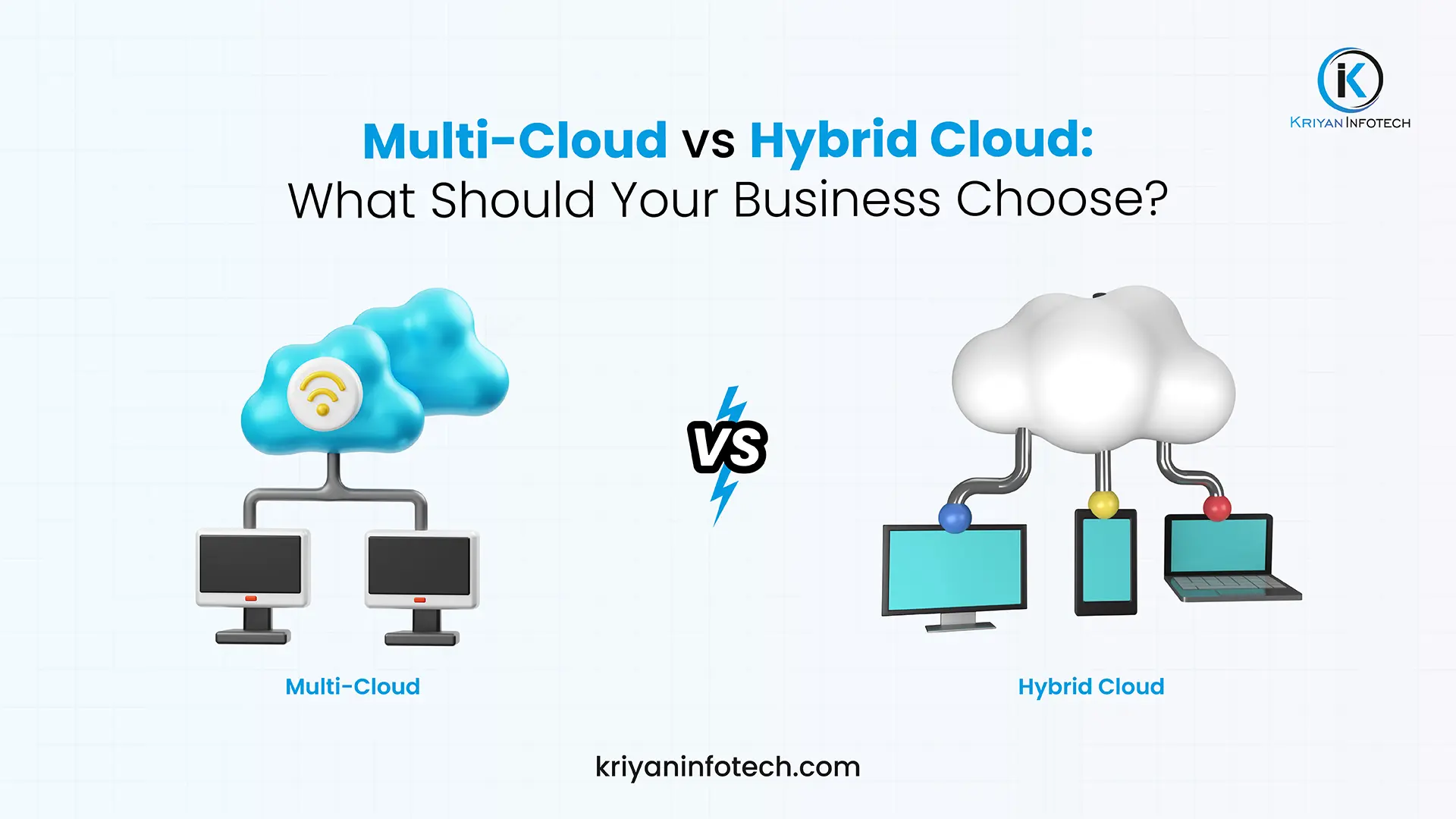
Hybrid cloud connects private and public environments. Multi-cloud connects multiple public clouds.
- Use Cases
Hybrid cloud supports legacy systems and compliance. Multi-cloud supports innovation, resilience, and global reach.
- Cost
Hybrid cloud may reduce data egress costs, but requires maintaining on-prem infrastructure. Multi-cloud can improve cloud cost optimization through pricing flexibility, but it increases management overhead.
- Complexity
Hybrid cloud complexity lies in integration. Multi-cloud complexity lies in orchestration and monitoring across platforms.
Example
A fintech company is planning to expanding into new markets.
Its core transaction engine runs on legacy systems that must meet strict regulatory requirements. At the same time, the company wants to roll out AI-driven customer insights and mobile applications quickly.
A hybrid cloud architecture allows sensitive transaction data to stay on-prem while AI workloads scale on the public cloud. Later, as the company expands globally, it adopts a multi-cloud strategy to host customer-facing apps closer to users, improving latency and uptime.
This phased approach shows that the choice is not always binary. Many organisations evolve from hybrid to multi-cloud over time.
Cloud Infrastructure Strategy: Where to Start
Choosing between multi-cloud vs hybrid cloud should begin with business needs, not vendor features.
Ask practical questions:
- Which workloads require strict compliance or low latency?
- How critical is vendor independence?
- Do you have in-house expertise to manage complex environments?
A cloud strategy consulting engagement can help align technical decisions with growth objectives, risk tolerance, and budget constraints.
Cloud Workload Distribution
Distributing workloads across environments improves resilience and performance.
Hybrid environments allow controlled workload movement between on-prem and cloud. Multi-cloud environments spread workloads across providers to reduce downtime risks and avoid regional outages.
The key is designing workload placement intentionally, not reactively.
Cloud Security Considerations
Security is shared between the cloud provider and the business, regardless of the model.
Key focus areas include:
- Identity and access management across platforms
- Data encryption at rest and in transit
- Unified monitoring and threat detection
Multi-cloud increases the surface area for misconfiguration, while hybrid cloud increases integration risks. Strong governance and consistent security policies are non-negotiable.
Cloud Cost Optimization in Real Terms
Cloud cost optimization is often the deciding factor.
Hybrid cloud helps optimise costs by keeping predictable workloads on-prem while scaling variable demand in the cloud.
Multi-cloud enables cost comparison across providers but requires active FinOps practices to prevent overspending.
Right-sizing resources, monitoring usage, and selecting cost-effective services must be continuous processes, not one-time exercises.
Integration Challenges to Expect
Hybrid cloud faces challenges in synchronising data and applications across environments.
Multi-cloud faces orchestration and interoperability issues between different platforms.
Without proper tooling and expertise, integration challenges can quickly erode the benefits of either model.
Performance Management Across Clouds
Managing performance across environments requires visibility.
Latency, load balancing, and real-time monitoring tools play a critical role. Multi-cloud environments benefit from global traffic routing, while hybrid setups benefit from predictable internal network performance.
Cloud performance management should be built into the architecture, not added later.
When Multi-Cloud Is the Right Choice
Multi-cloud makes sense when:
- Avoiding vendor lock-in is a priority
- High availability and redundancy are critical
- Global performance requirements vary by region
It suits digital-first enterprises with mature cloud teams.
When Hybrid Cloud Is the Right Choice
Hybrid cloud is ideal when:
- Legacy systems cannot be retired quickly
- Regulatory or data residency requirements exist
- Businesses want a controlled migration path
It suits enterprises balancing innovation with operational stability.
Enterprise Cloud Adoption Trends
Enterprises are increasingly combining AI with cloud platforms, adopting distributed cloud models, and formalising FinOps practices to control costs. The future is not about choosing one model forever, but about designing adaptable architectures.
Conclusion
There is no universally “better” option in the multi-cloud vs hybrid cloud debate. The right choice depends on your business priorities, risk appetite, and operational maturity.
If you are unsure where to begin, working with an experienced cloud consulting company can help you design a strategy grounded in reality, not assumptions. And if execution is the challenge, you may need to hire cloud engineers who understand both hybrid and multi-cloud environments.
Choosing the right cloud model today sets the foundation for growth tomorrow. The key is choosing with clarity, not confusion.